Psalm 8[a]
For the director of music. According to gittith.[b] A psalm of David.
1 Lord, our Lord,
how majestic is your name in all the earth!
You have set your glory
in the heavens.
2 Through the praise of children and infants
you have established a stronghold against your enemies,
to silence the foe and the avenger.
3 When I consider your heavens,
the work of your fingers,
the moon and the stars,
which you have set in place,
4 what is mankind that you are mindful of them,
human beings that you care for them?[c]
5 You have made them[d] a little lower than the angels[e]
and crowned them[f] with glory and honor.
6 You made them rulers over the works of your hands;
you put everything under their[g] feet:
7 all flocks and herds,
and the animals of the wild,
8 the birds in the sky,
and the fish in the sea,
all that swim the paths of the seas.
9 Lord, our Lord,
how majestic is your name in all the earth!
MEANING AND COMMENTARY
PSALM 8
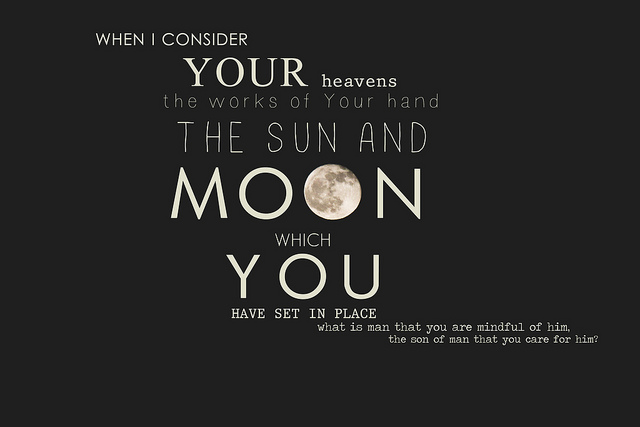
In the Old Testament, Psalm 8 is one of the many poems of David. This particular poem is titled “How Majestic Is Your Name” in the Literary Study Bible. It is a grouping of words that was directed to the choirmaster upon Gittith. The Psalmist who wrote this poem in song was expressing the great fortitude of God in all his actions. Upon the creation of mankind and all that he had blessed man with, even though they had turned against him repeatedly, God was still humble and forgiving. He still blessed man even though man sinned. In 8:4 it reads, “What is man that you are mindful of him, and the son of man that you care for him?” The point that the author of this Psalm was trying to get across was the idea of eternal forgiveness. Even after all the generations and the repentance of turning against God toward other idols, He was still forgiving.
The author of this Psalm could have had many reasons concerning the prompting of this excerpt. Whether it was a warning, a recognition, or a prophecy of the years to come. So what was the reason behind this? Why did David write this Psalm in the first place?

A commentary found at http://www.easyenglish.info/psalms/psalm008-taw.htm suggests that David was reminiscing on his past life when he was of lower power. In verse 6 it reads, “You have put all things under his feet, all sheep and oxen, and also the beasts of the field.” When David was in his younger years he kept sheep. He would even do this sometimes on the hill at night. This also could have been a possible reference to the line that reads, “When I look at the heavens, the work of your fingers, the moon and the stars, which you have set in place.” David possibly could have written this Psalm to reflect on his previous life when he was so small and weak before his anointing of king in 1 Samuel 16.

Some historical contexts found at http://christadelphianbooks.org/booker/psalms1/psabka16.html#Heading58 has poetic meanings behind some of the Psalm’s lines. For instance, in line 2 it says, “Out of the mouth of babies and infants, you have established strength because of your foes, to still the enemy and the avenger.” This particular verse could have been a poetic expression of David’s immaturity of his strength compared with Goliath’s. Or possibly a description of Saul during his reign as king in 1 Samuel. An article by Douglas J. Green found at http://www.wts.edu/resources/articles/green.html suggests that the majority opinion of the historical context is a ““song of creation” that gives “articulation to creation faith.”” In other words, the psalm is talking about human beings in general and the importance of their faith.
So, generally, we understand that Psalm 8 is a poem referring to the humanistic faith with God and His creations and blessings. Particularly, Psalm 8 is one of the Specialized Thanksgiving (Todah) Psalms according to http://www.cresourcei.org/psalmtypes.html. More specifically, it is a poem of salvation history. Although this psalm is grouped mainly in the historical salvation area, it is hard to pin point the actual belonging category because all of these psalms are able to fit in many other categories as well.

The use of figurative language is greatly seen throughout Psalm 8. For example, in verse 2 it says, “out of the mouth of babies and infants.” Figuratively, this is saying that God has given mankind strength just like a mother’s breast milk allows growth and strength. Also, in verse 5 it says, “And crowned him with glory and honor.” This particular verse is not literally saying that God has placed a crown on man’s head, but He has made man out of His own sight and has blessed mankind with righteousness. Another account of figurative language in this psalm is in verse 6. It says, “You have given him dominion over the works of your hands, you have put all things under his feet.” In this verse, David says that God has blessed mankind with many blessing that are undeserving.

Psalm 8 is a psalm that is sometimes used in contemporary culture. According to http://www.jesusbookandgiftiselinnj.com/product.asp?sku=0664255574, this particular psalm was inscribed on a disc and planted on the moon by the Apollo 11 crew. Another use of Psalm 8 is contemporary culture is in a song called “How Great is Our God” by Chris Tomlin.

Psalm 8 is a very popular psalm in my opinion. It is heard a lot within churches and songs. It is a psalm that greatly shows historical context concerning the life of David, humankind’s faith and salvation, and God’s forgivingness. All of these are components that are thought of today by Christians when dealing with daily life situations.
Comments
Post a Comment